
Understanding NYC Building Violations: HPD, DOB, ECB and OATH
October 8, 2026Last reviewed October 8, 2026
One building problem can create records with several NYC agencies, and paying a fine doesn't close any of them. A plain-English guide for small boards on what HPD, DOB and OATH violations mean and how to actually clear them.

Most small NYC buildings have at least one open violation on record. Often it's years old, and often nobody on the current board knows it exists. Then it surfaces at the worst moment: during a refinance, a sale, or an insurance renewal.
The confusing part is that NYC doesn't have one violation system. It has several, run by different agencies, and one problem can create records in more than one place. This guide explains who issues what, what each record means, and how a volunteer board can clear them.
Who issues violations
| Agency | What it covers | Typical issues in small buildings |
|---|---|---|
| HPD (Housing Preservation & Development) | Housing maintenance: conditions inside residential buildings | Leaks, mold, pests, missing window guards, heat and hot water, peeling paint |
| DOB (Department of Buildings) | Building code, construction, building systems | Work without permits, boiler and elevator filings, facade and parapet issues, gas piping |
| ECB / OATH | Summonses and the hearings that set fines | Penalties tied to DOB, sanitation, fire and other summonses |
| DOT | Sidewalks | Cracked or raised sidewalk flags in front of the building |
| FDNY, DEP, DSNY | Fire safety, water and air, sanitation | Fire safety notices, boiler emissions, trash setout |
HPD violations: the housing maintenance code
HPD inspects when someone complains (usually through 311) and issues violations by class.
| Class | Meaning | Time to correct | Time to certify the correction |
|---|---|---|---|
| A | Non-hazardous | 90 days | 2 weeks after the correction period |
| B | Hazardous | 30 days | 2 weeks after the correction period |
| C | Immediately hazardous | 24 hours (most); 21 days for lead paint, window guards, mold and pests; 14 days for self-closing doors; heat and hot water immediately | 5 days |
How to clear one: fix the condition, then submit a Certification of Correction to HPD, either online through eCertification or on paper, notarized. HPD may reinspect. If you fix something and never certify it, the violation stays open on the record indefinitely. This is the most common reason small buildings carry "zombie" violations from a decade ago.
What if a violation was issued in error, or the condition was fixed long ago? HPD has a process to request dismissal or reinspection.
DOB violations vs. ECB/OATH summonses
This is where most people get confused.
- A DOB violation is a record that a condition doesn't comply with the building code. On its own it usually doesn't carry a fine, but it stays on your building's record until DOB dismisses it.
- An ECB / OATH summons is a notice to appear at a hearing at the Office of Administrative Trials and Hearings (OATH). That's where a penalty is set.
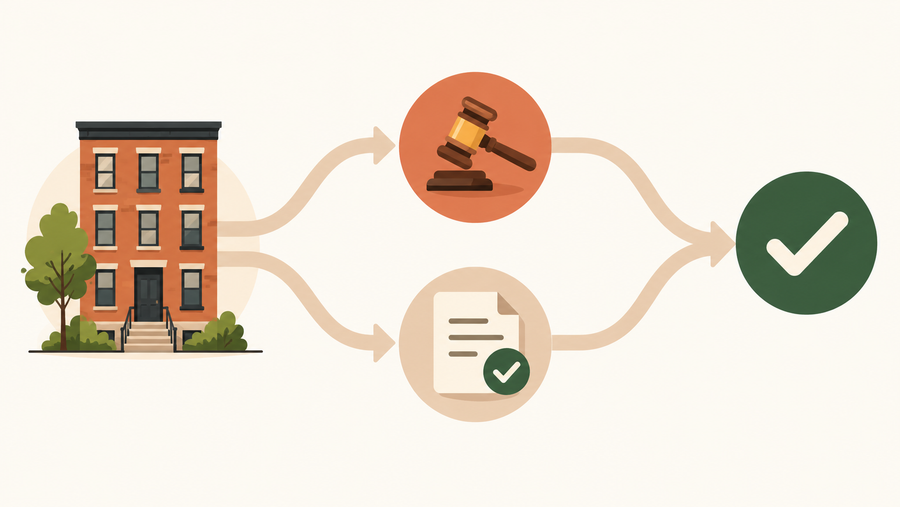
The same problem can produce both. Paying an OATH penalty does not close the DOB side. DOB's guidance is explicit that paying a penalty doesn't end your responsibilities: you still have to fix the condition and get DOB to approve a correction.
Responding to an OATH summons
You generally have three options:
- Cure it (if eligible). Some summonses can be cured by fixing the condition and filing an acceptable Certificate of Correction before the cure date. If DOB approves it, you skip the hearing and pay no penalty. Check the DOB penalty schedule to see if yours qualifies.
- Admit and pay, often at a reduced, standard penalty.
- Fight it at the hearing, in person, online or by phone, or by mail.
The one thing not to do is nothing. If no one shows up, OATH can find you in default and impose a higher penalty, usually the maximum.
Clearing the DOB side
After fixing the condition, file a Certificate of Correction with DOB's Administrative Enforcement Unit (form AEU2, with supporting documents such as photos, invoices or a professional's statement). Class 1 (immediately hazardous) conditions must be corrected right away. Until DOB accepts the certificate, the violation stays open.
Sidewalk violations (DOT)
In NYC, property owners are responsible for the sidewalk in front of their building. DOT can issue a notice of violation for defective sidewalk flags. If you don't repair it, the city can do the work and bill you. Sidewalk violations come up a lot during sales and refinances.
"Paid" is not the same as "resolved"
The pattern we see most often in small buildings looks like this:
- A summons arrives and someone pays the fine.
- The condition gets fixed, or doesn't.
- Nobody files the certificate of correction.
- Years later, a buyer's attorney, a lender or an insurer finds the open violation.
For each violation you want to know three things: Is the condition fixed? Is the penalty paid? Has the correction been certified and accepted? You need all three to be fully clear.
Why this matters for small buildings
- Sales and refinances: lenders and buyers' attorneys ask about open violations. Unresolved items can slow or derail a closing.
- Insurance: underwriters look at violation history at renewal.
- Penalties grow: unpaid OATH penalties accrue interest and can become judgments.
- Board turnover: the board that knew about a violation may be gone by the time it matters.
How to look up your building
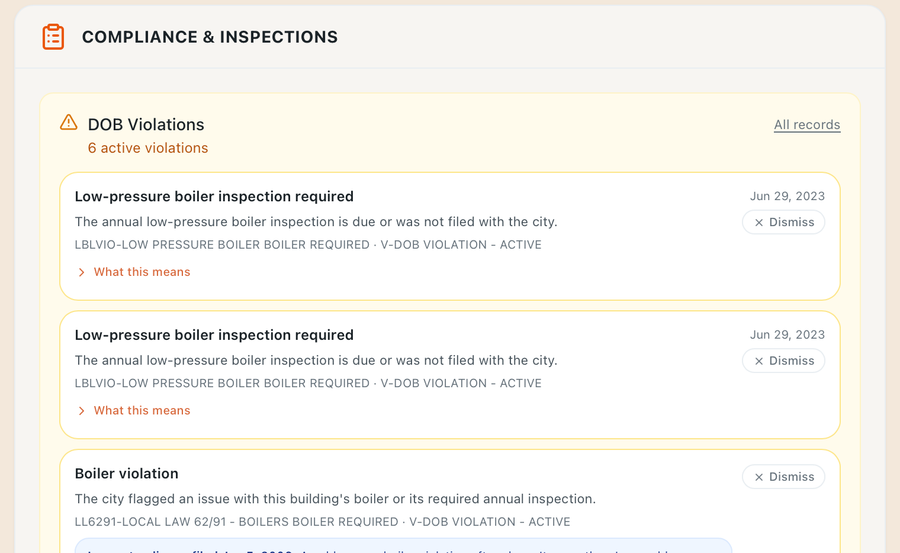
The records are public, but they live in different places: HPD Online for housing violations, DOB BIS and DOB NOW for building violations, and the OATH and ECB portals for summonses and penalties. Checking all of them by hand takes an afternoon, and you have to repeat it to catch new ones.
The Stoop Report pulls them into one view, flags what's open, and shows the fine amounts. OurStoop's paid plan then checks again every night and emails your board when something new appears.
Frequently asked questions
Our building has violations from before any of us were on the board. Are we responsible?
Yes. Violations attach to the property, not the people. The good news is that many old violations are for conditions that were fixed long ago and only need to be certified.
Can we just pay a DOB/ECB fine to make it go away?
Paying settles the penalty, but the DOB violation stays open until you file and get approval for a certificate of correction.
What does "Class C" mean and how fast do we have to act?
Class C is HPD's immediately hazardous category. Most must be corrected within 24 hours, and heat and hot water immediately. Certify the correction within 5 days.
Who should be the respondent on summonses in a condo or co-op?
Usually the condo board or co-op corporation, as the owner. Make sure your HPD registration and DOB contact information are current so notices reach the right person.